

How to Choose Georgia Rental Insurance
Landing at Tbilisi, Batumi, or Kutaisi airport is not the moment you want to decode insurance terms on your phone. If you are figuring out how to choose Georgia rental insurance, the smart approach is simple: match the coverage to your route, car type, and booking conditions before you confirm the reservation.
Insurance in Georgia is not one-size-fits-all. A compact car for city driving in Tbilisi has different risk factors than a crossover headed to Gudauri in winter or a minivan for a family trip across Kakheti and the Black Sea coast. The right choice is usually the one that fits your real trip, not the one with the most impressive label.
How to choose Georgia rental insurance for your trip
Start with your itinerary. Where you drive matters more than many travelers expect.
If your plan is mostly urban - airport pickup, hotel transfer, day trips around Tbilisi, Batumi, or Kutaisi - standard coverage may be enough if the terms are clear and you are comfortable with some financial responsibility in case of damage. Roads on these routes are generally straightforward, parking incidents are more common than major accidents, and your main concern may be glass, bumpers, and other low-speed damage.
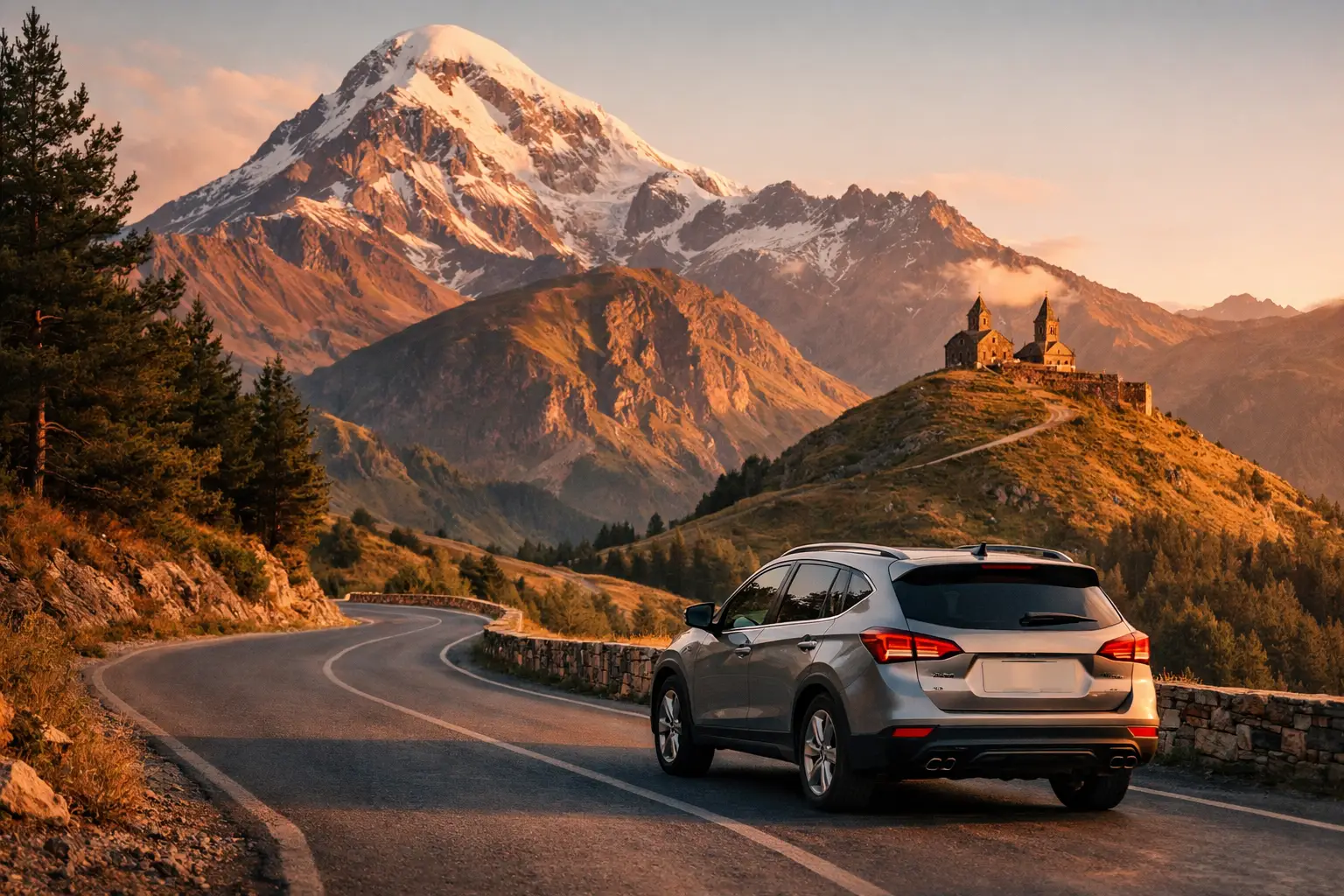
If you are heading to mountain areas such as Gudauri, Kazbegi, Bakuriani, or Mestia, you should look more closely at what the policy actually covers. Mountain roads bring sharper turns, changing weather, gravel sections on some routes, and a higher chance of tire or underbody issues depending on the season and exact destination. In these cases, broader protection can make sense, especially if you are not familiar with Georgian road conditions.
The same logic applies if you are planning a longer self-drive loop. A week of airport transfers and city parking is one thing. Ten days across wine country, the coast, and the mountains increases exposure simply because you are driving more.
Know what the insurance is covering
The phrase “insured car” does not tell you enough. You need to check what kind of protection is included in the booking and what remains your responsibility.
In practical terms, most travelers should pay attention to four areas: damage to the rental car, third-party liability, theft protection, and exclusions. Liability matters because it relates to damage or injury involving others. Vehicle damage coverage matters because even a minor parking scrape can become an expensive problem if the terms are vague. Theft protection is relevant, but for many travelers in Georgia, the more common day-to-day issue is accidental damage rather than theft.
Exclusions are where mistakes happen. Some policies do not cover tires, windshield damage, mirrors, the underbody, or driving on certain road types. Others may not apply if an unauthorized driver is behind the wheel, if local reporting rules are not followed after an incident, or if the car is taken outside permitted areas.
That is why clear wording matters more than marketing language. A shorter, transparent policy is often more useful than a broader-sounding package that leaves major gaps in the fine print.
The deposit question changes the insurance decision
Many international travelers care as much about the deposit as the insurance itself. That is especially true for younger renters, debit-card users, and visitors who do not want a large amount blocked during the trip.
This is where you need to read the booking terms together, not separately. A no-deposit rental can be very convenient, but you still need to understand what happens if the car is damaged. On the other hand, a booking with a deposit may offer a different insurance structure that reduces your exposure in another way.
Neither option is automatically better. It depends on your cash flow, payment method, and comfort level. If keeping your available funds free matters more than anything else, no-deposit terms can be the better fit. If you want the strongest possible protection against out-of-pocket repair costs, you may prefer a package that changes how responsibility is handled after an incident.
Choose coverage based on the car, not just the destination
Vehicle type changes the insurance conversation.
If you are renting an economy car for Tbilisi or Batumi, you may care most about practical city risks like parking damage and mirrors. If you are booking a crossover for winter travel or a route with mountain roads, you should pay more attention to tires, glass, road assistance, and exclusions tied to terrain or seasonal conditions.
For minivans, camper vans, and motorhomes, the stakes are different again. These vehicles are larger, harder to maneuver in tight urban spaces, and more expensive to repair. Extra coverage can be worth it simply because low-speed contact with walls, gates, or poles is more likely when driving a larger vehicle in unfamiliar areas.
Premium and chauffeur-booked cars are another case. If the vehicle category is more expensive, even cosmetic damage may carry greater consequences. For special-event bookings such as wedding transport, clarity matters more than ever because timing is tight and disruptions are costly.
How to choose Georgia rental insurance if you plan border travel
Some travelers want to take the car beyond Georgia during the trip. That changes the insurance check immediately.
If you plan to cross into Armenia through Sadakhlo or Turkey through Sarpi, you need to confirm that cross-border travel is allowed and that the insurance remains valid outside Georgia. Do not assume domestic coverage automatically follows the car across the border. It often depends on prior approval and vehicle-specific rules.
Just as important, some borders are not permitted for rental travel. That is a booking rule issue, but it also becomes an insurance issue the moment a car is driven somewhere outside the allowed terms. If your route includes any border crossing, confirm it before payment, not on pickup day.
Airport arrivals need simpler insurance, not more confusing insurance
After a flight, people tend to accept whatever sounds easiest. That is exactly when details get missed.
If you are arranging delivery to Tbilisi Airport, Batumi Airport, or Kutaisi Airport, choose insurance terms that you can understand quickly and verify before arrival. Look for clear pre-booking information on what is included, what documents are needed in case of an incident, and whether roadside support is available. When the car is delivered directly to you, there is less room for a long counter discussion, so clarity before arrival matters more.
This is one reason many travelers prefer verified local supply with exact-car confirmation and straightforward booking rules. Platforms such as TripBox are built around that kind of low-friction process, which is especially useful for international arrivals who want the car shown to be the car delivered.
Don’t overbuy, but don’t underinsure
There is always a trade-off.
Some travelers buy the maximum available coverage for peace of mind, even when their trip is short and simple. Others choose the most basic option to keep the booking cost lower. Both choices can be right, but both can also be mismatched.
If you are staying in one city, driving short distances, parking in secure places, and renting a standard car, basic or mid-level coverage may be enough. If you are driving across regions, arriving in winter, sharing the wheel, or choosing a larger or higher-value vehicle, stronger protection is usually the more practical call.
The key is not to think of insurance as a checkbox. Think of it as part of route planning. A road trip to Mtskheta and Gori is different from a ski transfer to Gudauri. A coastal stay in Kobuleti, Gonio, Kvariati, or Sarpi is different from a multi-stop itinerary that includes Vardzia and mountain roads. Good insurance should fit the trip you are actually taking.
What to ask before you book
Before you confirm any rental, ask a few direct questions in plain language. What damage is covered? What is excluded? Are tires, glass, mirrors, and the underbody included? Is roadside help part of the booking? Are additional drivers allowed under the same insurance terms? Are border crossings permitted if your route requires them?
Also ask what you must do if something happens. In many cases, coverage depends on reporting the incident correctly and promptly. If you do not know the procedure, even good insurance can become difficult to use.
Reliable providers should be able to answer these questions clearly. If the explanations are vague, overly complicated, or inconsistent, that is a warning sign by itself.
The best choice is the one you can understand
The strongest insurance decision is not always the most expensive package. It is the one that clearly matches your route, vehicle, and booking style, with no surprises hidden behind unfamiliar terms.
If you can explain your own coverage in one or two sentences before the trip starts, you are probably making a solid choice. And if you cannot, pause the booking and ask again - because confidence on Georgian roads starts before you turn the key.